


Always-on AI, unanswered costs
Microsoft’s tireless agent meets the reality of the bill
Build 2026 puts continuous AI work in the spotlight. Explore what the agent could do, what remains unconfirmed, and why pricing and oversight matter before you commit.

What continuous agents could change
Routine follow-ups, handled sooner
An authorized agent could track open items and draft reminders between meetings, giving teams more time for decisions that need judgment.
Work that crosses shifts
Continuous operation could help move approved tasks forward overnight, but connections, permissions, and service availability will determine the real benefit.
Costs that need watching
Always-on activity may generate ongoing usage and licensing charges. Set budgets and review Microsoft’s published terms before scaling.
People stay accountable
Require clear approvals, audit trails, and escalation paths so a missed signal or mistaken action does not become an unattended problem.
Build 2026: Microsoft ships an agent that never sleeps — and a bill nobody has seen
On 2 June 2026, at Fort Mason in San Francisco, Satya Nadella announced a new category of software: Autopilots, described as “always-on agents that work autonomously, with their own identity, and act on your behalf”. The first of them, Microsoft Scout, is already running in experimental release. What is genuinely new, what is slide-ware, and what should a budget-holder make of a launch with no prices?
The short answer: the announcement matters less for what Scout does today than for what it licences tomorrow. Microsoft has spent three years climbing a ladder it now spells out openly — Chat, Cowork, Code, Autopilots — and Scout is the first product that is not summoned but resident. Yet the commercial terms are a blank: no pricing, no confirmed general-availability date, and access gated behind an invitation programme. For enterprises, Build 2026 is therefore two stories at once: a credible technical milestone, and a negotiation that has not yet begun. This piece separates the two.
What actually shipped — and what is still a slide
Sorting the keynote into drawers is the quickest way to see the shape of Microsoft’s bet. In the shipping drawer: Work IQ APIs, generally available from 16 June 2026 and metered in Copilot Credits, which turns the corporate memory of Microsoft 365 into a paid programming interface; Agent 365, GA since 1 May, now with an SDK and a preview orchestrator; and the Foundry autopilot agents in public preview, which carry their own Entra identity, a mailbox and a presence in Teams. Also real: seven new MAI models, including the first reasoning model, MAI-Thinking-1, and a fast code model, MAI-Code-1-Flash — Microsoft’s quiet bid to price down its dependence on outside laboratories.
In the preview drawer: Frontier Tuning, which lets an enterprise fine-tune a frontier model inside its own compliance boundary; Execution Containers, sandboxes in which agents may act without touching production systems; and the unified context layer Microsoft IQ — Work, Fabric, Foundry and a new Web IQ, which the company says grounds web retrieval 2.5 times faster. That multiplier is a vendor claim awaiting independent measurement. In the concept drawer: Project Solara, a chip-to-cloud platform for agent-era devices shown as a wearable badge and a desk companion, and Majorana 2, a topological quantum chip whose significance physicists will argue about for years. Neither belongs in a 2026 roadmap, and neither, to Microsoft’s credit, was presented as one.
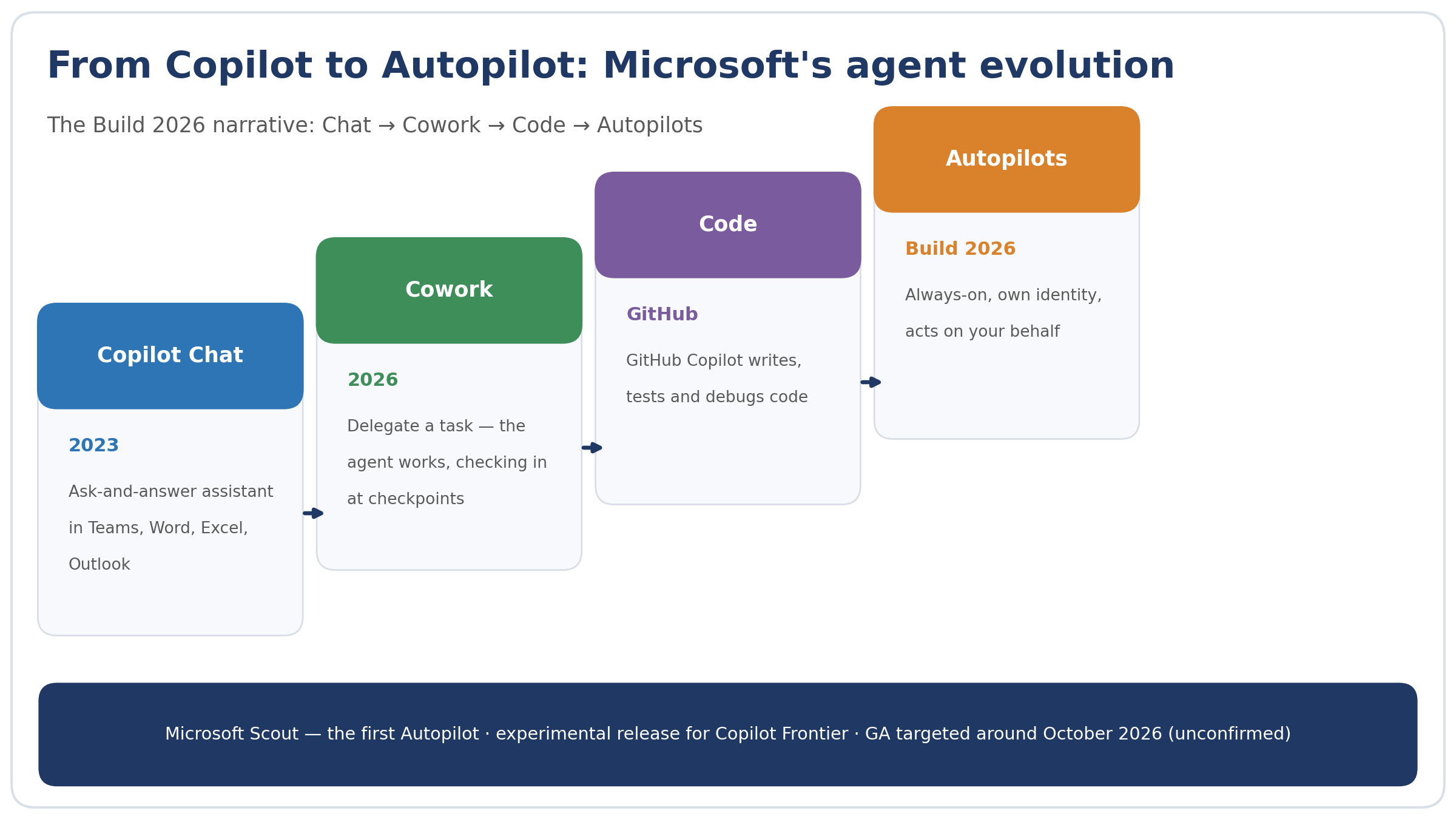
Microsoft's agent ladder: from Copilot Chat through Cowork and GitHub Copilot to the Autopilots category announced at Build 2026
Scout, anatomised: a digital twin with a name badge
Strip the demo gloss away and Scout is best understood as a digital twin of a knowledge worker’s working week. Built on OpenClaw — the open-source framework whose author Peter Steinberger Microsoft acquired earlier in 2026 — and fuelled by Work IQ, it lives in the cloud, in a desktop application for Windows and macOS, and in the browser, reaching Teams, Outlook, OneDrive, SharePoint, the local filesystem and external services through MCP servers. Its advertised chores are the familiar liturgy of executive time: preparing for meetings, unpicking diary clashes, ensuring the important message is not buried, protecting focus hours, flagging decisions that have stalled.
The behavioural shift is the point. Cowork waits to be given a task; Scout monitors, proposes and acts, returning for approval at defined thresholds. That inverts an assumption a decade of SaaS quietly taught us: that software is somewhere we go. Scout is somewhere that goes. Which is why the most consequential engineering in it is not the model but the badge — the governed identity it carries.
The identity question
Every action Scout takes is attributable to its own Microsoft Entra identity, scoped by Purview sensitivity labels and data-loss-prevention policy evaluated before the action, not after it. Sensitive operations can require a human sign-off, and the full trail lands in an audit log. In security terms this is Zero Trust extended to a new species of principal: the same conditional access, least-privilege and review disciplines an enterprise applies to staff now apply, one-for-one, to their agents. For regulated industries this is the difference between a deployable product and a compliance impossibility — and it is where Microsoft’s enterprise pitch beats the consumer alternative.
Google’s Gemini Spark, available since May under the AI Ultra subscription, offers a broadly comparable always-on companion. But Spark’s natural habitat is the individual consumer; Scout’s is the governed organisation. The comparison that should worry Microsoft is not Google’s but its own customers’ patience: an agent with a name badge is also an agent whose permissions, prompts and logs a security team must now own. Firms that have not yet labelled their sensitive data or disciplined their Copilot Studio agents will find Scout inherits the mess, obediently and at machine speed.
The pricing black hole
Here the record is genuinely blank. No prices were announced. Unconfirmed signals suggest an add-on for Microsoft 365 E3 with inclusion in E5; general availability is pencilled for roughly October 2026. Access to the experiment itself requires participation in the Copilot Frontier programme, Intune-managed devices, an explicit opt-in attestation from the employee, and a GitHub Copilot licence. Until the commercial terms land, any figure attached to Scout in the wider press should be treated as speculation. The sensible budget posture is a scenario, not a commitment: model a premium E3 uplift alongside the existing Copilot Credits consumption line, and treat the E5 bundle as a negotiating hypothesis to test with a Microsoft partner rather than a fact to bank.
A ninety-day readiness audit, sized for a mid-market firm
Consider an illustrative professional-services firm of 800 staff on Microsoft 365 E5. Days 1–30: verify Intune coverage across the pilot population, file the Copilot Frontier application through a partner, and audit Purview — an agent is only as disciplined as the data classification it inherits. Days 31–60: run a 30-person pilot of executives and their assistants, instrumented for hours spent on diary management and inbox triage (self-reported baselines of five to eight hours a week are a reasonable planning assumption), the share of Scout actions requiring human approval, and the rejection rate. Days 61–90: review against pre-agreed thresholds — time reclaimed, zero security incidents, user satisfaction — and only then discuss scale. Every figure here is a working assumption; the point of the exercise is that when pricing does appear, this firm negotiates with its own telemetry rather than Microsoft’s slides.
What to watch in the rest of 2026
Three dates matter more than any keynote replay. The expansion of the Scout preview beyond Frontier participants, expected in the coming weeks. The GA of Work IQ APIs on 16 June, whose consumption billing in Copilot Credits will give the market its first real price signal for agentic context. And the October window in which Microsoft has hinted at general availability — the moment the add-on-versus-bundle question stops being rumour. Around them, watch the MAI model line: each release of a capable in-house model compresses the cost per task across Cowork, Scout and every Copilot Studio agent an enterprise has already built. The strategic read is unglamorous but important: Microsoft is assembling an agent estate in which the identity, the memory, the models and the meter are all its own. Build 2026 was the estate agent’s opening brochure. The rent negotiation starts in October.
What We Know—and What We Still Need to Know
What Microsoft Has Announced
An agent designed to operate continuously
Presented as part of Microsoft’s Build 2026 announcements
Intended to support work beyond a single prompt
Potential for ongoing business workflows
A new option for teams evaluating AI automation
What Remains Unclear
Subscription price and billing model
Usage limits and metered charges
Eligible plans and licensing requirements
Release dates and regional availability
Controls for monitoring continuous-operation costs
Frequently Asked Questions
Here’s what businesses can establish now—and what to check before planning a rollout.
Is Scout a replacement for Copilot Cowork?
No. Cowork handles delegated tasks with checkpoints; Scout is the always-on layer that watches and acts on your behalf. They are adjacent layers, not substitutes.
When will the agent be released?
A general release date has not been confirmed in the information available. Check Microsoft’s official product updates for preview and launch timelines before scheduling deployment.
Who will be able to use it?
Plan eligibility, geographic availability, and licensing requirements remain unclear. Confirm that your Microsoft tenant and licenses qualify before assuming your team will have access.
Does continuous operation mean it runs without oversight?
No. Continuous operation describes how the agent can work over time, not a reason to skip supervision. Define permissions, approval points, monitoring, and a way to stop it before putting it to work.
What should we check before committing to it?
Request written pricing and usage limits, then verify licensing, security controls, data access, and expected workload costs. Our 24/7 team can help review official Microsoft licensing options when details become available.
Is an always-on agent safe?
Technically, Microsoft has built the right scaffolding — Entra identity, Purview DLP, human approval, full audit. Practically, safety is your configuration: least-privilege access, labelled data and periodic access reviews are not optional extras.